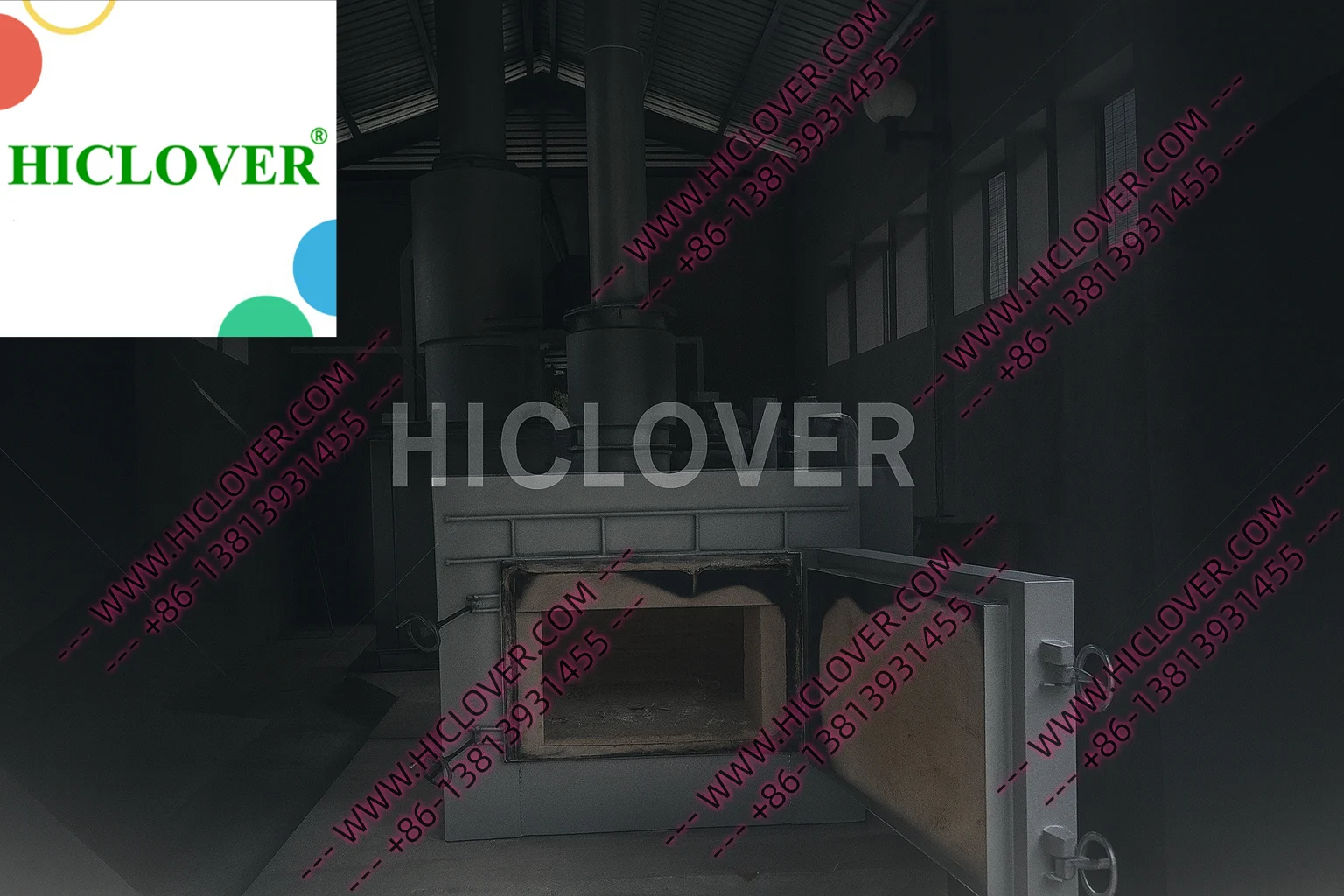
HICLOVER Incinerator: Industrial-Grade Waste Incinerators for Modern Waste Management Standards
Technical Foundation of HICLOVER Waste Incinerators
The waste incinerators engineered by HICLOVER set a technical standard for reliable, compliant, and energy-efficient thermal destruction of hazardous and regulated waste streams. Engineered to meet strict medical incinerator operating temperature standards, such as the WHO benchmark of 850–1100°C for primary and secondary combustion chambers, HICLOVER systems are designed for both red bag waste incinerator processes and broader hazardous disposal. Each machine features dual combustion chambers with high refractory linings, ensuring sustained high-temperature retention for optimal pathogen destruction and dioxin minimization. Across all designs—fixed, containerized, and mobile—the brand emphasizes process stability, critical for healthcare, crisis response, and decentralized waste management scenarios.
HICLOVER’s engineering is informed by decades of direct manufacturing experience, with each system calibrated to support a range of waste calorific values, including high-energy medical waste heat value conditions. With strict adherence to international compliance, from EU flue gas limits to World Health Organization guidelines, the incinerators deliver the temperature uniformity and residence time needed for regulatory assurance in medical, pharmaceutical, and hazardous waste contexts.
Combustion Principles and Chamber Design
At the core of HICLOVER’s portfolio lies robust dual-chamber architecture. The primary chamber operates at 850°C or higher, ensuring thorough volatilization of organic compounds and initial breakdown of infectious agents. The secondary chamber, equipped with forced air injection and high-efficiency burners (diesel, LPG, or natural gas), sustains temperatures up to 1100°C for a minimum residence time exceeding two seconds. This configuration is fundamental for the complete oxidation of CO, VOCs, and hazardous byproducts. To meet stringent standards such as those articulated in medical+incinerator+secondary+chamber+temperature+standard, HICLOVER incorporates precise temperature monitoring and PLC-regulated burner sequencing, guaranteeing both safety and environmental compliance.
The emphasis on robust refractory linings and advanced combustion airflow management ensures that even high-lipid, high-protein, or synthetic-laden medical and pharmaceutical wastes—characterized by elevated calorific values—are efficiently reduced to inert ash while minimizing dioxin and furan formation. This is particularly relevant for specialized applications, including marijuana incinerator use, where both organic content and odor control pose unique technical challenges.
Regulatory Compliance and Emission Control Systems
International regulatory regimes, from the European Waste Incineration Directive (WID) to World Health Organization guidance, prescribe stringent emission profiles for medical waste incinerator manufactures and operators. HICLOVER addresses these requirements through modular, scalable flue gas treatment. Facilities can select either dry scrubber or wet scrubber systems, each designed to target acid gases, particulates, and heavy metals before atmospheric release. Dry scrubbers feature reagent injection (lime or sodium bicarbonate) and high-efficiency dust collection, while wet scrubbers employ liquid absorption and demisters for enhanced pollutant removal. Integration of advanced filter media and continuous emissions monitoring further supports ESG compliance and carbon reduction efforts.
For organizations needing adaptability in dynamic or remote environments—such as the Kenya solid waste incinerator manufacturers portfolio or rapid-deployment units for humanitarian response in Chad (Chad UNDP incinerator) and Senegal hospital settings (Senegal hospital incinerator)—HICLOVER’s modular scrubber options are tailored for both containerized and mobile deployments.
Comparative Assessment of Incinerator Types and Automation
Fixed vs. Containerized and Mobile Modular Systems
Traditional fixed incinerators remain the backbone of large-scale medical and hazardous waste management, providing high throughput and robust permanence. However, the global trend towards decentralized and crisis-responsive infrastructure has driven demand for containerized and mobile incinerators. HICLOVER’s mobile plug-and-play units—housed within ISO standard containers—enable rapid commissioning and relocation, crucial for field hospitals, emergency zones, and remote mining or oil camps. These systems are insulated for thermal efficiency and engineered for shock-resistant transport, ensuring operational continuity even in adverse environments. Their modularity allows for scalable waste volume handling, with chamber sizes customized to client requirements.
Advanced Controls: PLC vs. Manual Operation
Digital automation represents a major advancement in waste incineration technology. HICLOVER integrates programmable logic controllers (PLC) for temperature, airflow, and combustion optimization, reducing human error and improving process repeatability. With PLC systems, operators benefit from real-time data logging, auto-alarm functions, and remote diagnostic capability—supporting both regulatory documentation and predictive maintenance. For remote sites or regions with limited technical resources, HICLOVER also offers simplified manual control panels, ensuring accessibility without compromising on safety or combustion quality.
The comparative advantage of PLC-driven automation is evident in energy efficiency and emissions consistency, aligning with the global shift towards digital industrial infrastructure and ESG-focused facility management.
Emission Control: Dry Scrubber vs. Wet Scrubber
Selection between dry and wet scrubbers is determined by waste composition, regulatory limits, and installation context. Dry scrubbers excel in compactness and reduced water use, while wet scrubbers deliver superior acid gas removal for installations handling high-chlorine or moisture-rich waste streams. HICLOVER’s engineering team provides tailored solutions, with all ancillary systems factory-assembled and pre-tested to minimize on-site commissioning time and technical risk.
Application Scenarios and Global Export Capability
HICLOVER’s supply chain resilience and direct manufacturing model positions the brand as a manufacturer of hazardous waste incinerator in China with robust export experience to over 70 countries. The company’s mobile and containerized solutions are deployed in field hospitals, border quarantine stations, and UN-coordinated humanitarian camps, supporting global infectious disease preparedness and crisis waste management. Facility design supports region-specific waste streams, from Kenya solid waste incinerator manufacturers requirements to the high-volume medical waste disposal seen in Central and West African hospitals.
Custom chamber volumes (from 20kg/hour to 500kg/hour and above) are available, addressing both small-scale clinics and large urban medical centers. Engineering designs are compliant with local grid power, generator supply, or multi-fuel operation (diesel, LPG, natural gas), maximizing flexibility for challenging geographies. The plug-and-play configuration of containerized incinerators ensures minimal site work and rapid scaling, essential for NGOs, governments, and private operators seeking rapid waste infrastructure deployment.
Direct Factory Manufacturing and Engineering Experience
All HICLOVER medical incinerators are produced in-house, supported by ISO-certified production lines and rigorous end-of-line testing. Unlike trading companies, direct factory supply enables superior quality control, responsive technical adaptation, and stable lead times. The engineering team’s extensive experience—demonstrated across projects in Asia, Africa, and the Middle East—ensures each system is tailored for site-specific environmental and regulatory conditions. This capability is reflected in the stable export pipeline for specialized markets, including portable medical waste incinerator manufacture companies in China.
For detailed system configurations, component specifications, and technical consultancy, reference resources are available directly from the HICLOVER official website. The technical documentation covers full lifecycle support, from system selection and installation to operator training and maintenance protocols.
Strategic Trends Shaping the Waste Incinerator Sector
Rapidly evolving global health threats highlight the importance of decentralized, resilient waste destruction infrastructure. HICLOVER’s mobile and containerized incinerators align with the global trend towards decentralized waste management and infectious disease preparedness. The integration of digital automation in industrial equipment, energy recovery modules, and modular emission control enables operators to meet rising carbon emission reduction and ESG compliance pressures without sacrificing operational reliability.
Supply chain resilience, bolstered by direct factory control and local spare parts support, further distinguishes HICLOVER in an era of logistical uncertainty. As governments and NGOs prioritize rapid response to pandemics, environmental disasters, and regional waste surges, the engineering adaptability and stable supply offered by HICLOVER’s waste incinerator systems deliver enduring value.
Conclusion: Engineering Reliability and Global Applicability
The HICLOVER waste incinerator series—spanning red bag waste incinerator, marijuana incinerator, medical waste incinerator manufactures, and multi-fuel containerized units—represents an industrial-grade solution to today’s complex waste management challenges. Combining advanced combustion technology, modular construction, and digital process control, these systems meet international regulatory standards while supporting global efforts in health security, environmental protection, and infrastructure resilience. Engineering expertise, in-house manufacturing, and an agile export platform position HICLOVER at the forefront of modern waste incineration technology.
